

The FMB Code of Conduct and Disputes
Hiring a contractor for a major extension or refurbishment commits serious money to one firm. The FMB Code of Conduct sets the professional benchmark that every Federation of Master Builders member must meet. It covers written contracts, insurance cover, safety duties and handover documents. In practice, that detail decides whether a project runs cleanly or ends in argument.
Most homeowners only test these protections once something goes wrong. A disputed variation, a delayed programme or defective workmanship quickly exposes weak paperwork. So what does membership actually guarantee, and what happens when direct talks with your builder break down?
Key Takeaways
- Members must issue a written contract or firm quotation before any construction work starts on site.
- Applicants pass an independent site inspection and financial vetting before the federation grants Master Builder status.
- Members must hold public liability cover and employers’ liability insurance of at least five million pounds.
- Conciliation and independent mediation give clients a low-cost route to settle disputes without court proceedings.
- Serious breaches trigger disciplinary action, from remedial orders and reprimands to suspension or permanent expulsion.
Core Standards Every Member Firm Must Meet
The code converts professional promises into measurable obligations. Each requirement applies from the first quotation through to practical completion. The federation audits compliance rather than taking a builder’s word for it. For a homeowner, two moments matter most: contract signature and the first serious problem on site.
The table below summarises the main duties placed on member firms. It also shows what each duty delivers for the client. From experience across the sector, these are the areas that decide whether a dispute stays manageable. Each one can be checked independently before you appoint a builder, not after the work begins.
| Regulatory Area | Mandatory Member Requirement | Consumer Protection Outcome |
|---|---|---|
| Contractual Terms | Written contract and clear quotation | Removes scope disputes and price ambiguity |
| Financial Verification | Credit and solvency checks | Mitigates contractor insolvency risk |
| Statutory Safety | Full compliance with CDM 2015 | Ensures safe, legally managed sites |
| Insurance Cover | Public, employers’ and contract works cover | Shields clients from third-party liabilities |
| Dispute Process | Submission to conciliation and mediation | Provides low-cost, impartial resolution |
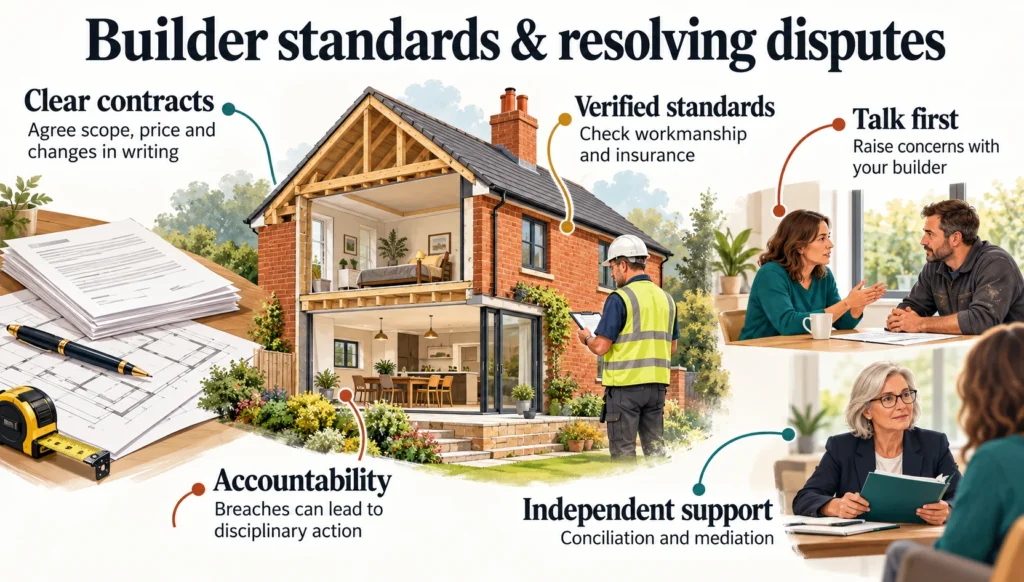
Contract Documents Before Work Starts
Written Contracts and Scope Clarity
The code requires a written contract or detailed quotation before construction starts. Clear documentation removes argument over pricing, stage payments, programme duration and design scope. Standard forms such as the JCT Home Owner Contract or Minor Works Building Contract suit residential schemes. They give both parties a sound legal footing from the outset.
Verbal agreements create unacceptable risk for both property owner and contractor. A formal document records agreed tolerances, site access, working hours and the contract sum. It also sets out how the builder instructs variations when unexpected ground conditions emerge. Fixing payment dates in advance prevents arbitrary mid-project price increases.
Quotations Versus Estimates
Federation rules require builders to distinguish a firm quotation from a non-binding estimate. A quotation is a fixed commercial offer and binds the builder once the client accepts it. An estimate gives only an indicative figure. Builders use estimates where ground conditions or hidden structural elements remain unknown at tender stage.
Compliant builders define every provisional sum within the contract documents. Undefined allowances expose clients financially because they exclude programme time and preliminaries. In practice, we find that vague provisional sums cause more final account disputes than any other item. Itemised pricing lets homeowners control capital expenditure accurately.
Statutory Safety and Building Control Duties
Health and Safety Duties on Site
Members must comply with UK health and safety law, including the Construction (Design and Management) Regulations 2015. On domestic projects, Regulation 7 transfers the client duties to the contractor or principal contractor. That shift demands disciplined risk management, adequate welfare facilities and controlled site access throughout the build.
A compliant principal contractor prepares a project-specific construction phase plan before work begins. The plan sets out safe systems of work for high-risk tasks such as steel erection and excavation. Contractors also check that every tradesperson holds a valid competence card and completes a site induction.
Building Regulations Verification
The code requires works to meet the Building Regulations 2010 in full. Builders must work with local authority building control or a registered building control approver. Inspectors check structural, fire and thermal elements before following trades cover them. Missing an inspection stage usually means opening up completed work later.
The 2023 amendments to the Building Regulations placed a clear onus on dutyholder competence. Members must satisfy the Approved Documents, from structural stability under Part A to thermal performance under Part L. Handing over the building control completion certificate at practical completion remains an absolute requirement.
Did You Know?
Section 135 of the Building Safety Act 2022 extended the limitation period for claims under the Defective Premises Act 1972. Claims now run to 30 years retrospectively for completed dwellings and 15 years prospectively for new work.
Insurance Cover and Financial Standing
Mandatory Insurance Cover
Members must satisfy the FMB insurance requirements before the federation grants or renews accreditation. Any firm employing staff needs employers’ liability insurance of at least five million pounds. Public liability cover sits alongside it. Together these policies answer claims for site injury, third-party property damage and structural harm.
Contract works insurance covers the permanent structure and unfixed materials against fire, flood and theft. Where a builder works on an existing house, JCT Insurance Option C applies and requires joint-names cover. Always ask to see a current certificate. Checking the policy before signing avoids a serious uninsured loss later.
Financial Vetting and Insurance-Backed Guarantees
The federation checks financial stability and credit history before granting Master Builder membership. Ongoing solvency checks confirm that member businesses trade responsibly. Members must also offer eligible clients the option of an insurance-backed guarantee. That guarantee matters far more than a standard workmanship warranty when a contractor fails.
A workmanship warranty binds only the contracting company during the defects liability period. If that company ceases trading, the warranty is worthless. An insurance-backed guarantee transfers rectification liability to an authorised insurer instead. Cover commonly runs for up to ten years from practical completion.
Workmanship Standards and Project Handover
Independent Inspection and Technical Competence
Applicants must pass an independent site inspection before joining the federation register. Assessors examine brickwork, joinery, waterproofing and general craft execution on live projects. Members face periodic re-inspection to confirm that standards hold over time. A failed inspection blocks membership until the firm corrects the shortfall.
Inspection confirms that contractors build to the structural calculations and architectural specification. Unauthorised material substitution undermines performance and breaches the trade agreement. From experience across the sector, substitution usually surfaces at handover, when certification no longer matches the installed product. Members follow manufacturer datasheets, British Standards and architect instructions on every installation.
Handover Documents and Certification
Members must supply a complete handover pack at practical completion. The pack includes the electrical installation certificate issued under BS 7671 and Gas Safe commissioning records. Clients also receive manufacturer warranties, operating manuals and the building control completion certificate. Each document has a direct legal or commercial purpose later.
Complete documentation protects homeowners when selling a property or claiming on building insurance. Missing Part P electrical notification or building control sign-off stalls conveyancing enquiries. Solicitors then require indemnity insurance or retrospective regularisation, both of which cost money. The code ensures clients hold every document before the contractor leaves site.
Communication and Variation Control
Client Reporting and Progress Updates
The code treats clear, consistent communication as a core professional obligation. Builders must give regular programme updates and raise emerging technical problems immediately. Transparent reporting keeps clients aligned with progress milestones. It also allows both parties to settle small disagreements before they harden into formal disputes.
On complex renovations, a weekly or fortnightly site meeting works best. Documented minutes record specialist lead times, subcontractor attendance and material delivery dates. In practice, we find that written minutes resolve most arguments about who agreed what. Proactive reporting stops minor misunderstandings escalating into contractual claims.
Written Variation Management
The code requires written agreement on every variation before site teams carry out the change. Verbal instructions generate bitter disputes over additional labour cost and revised completion dates. A formal variation notice records the technical adjustment, the agreed price and any programme extension. Both parties sign it.
Contract administrators insist on this discipline for architect-led residential schemes. When subsoil problems or design changes emerge, the contractor prices the delay and the extra work. The client then decides with full cost visibility. That record protects the final account from retrospective claims neither side can evidence.
What We Build

House extensions
Single, double-storey and wraparound extensions — load-bearing structure engineered, materials matched to existing fabric, full Building Regulations compliance.

Home renovation
Whole-house renovation before you move in. Structural reconfiguration, open-plan steelwork, drainage, energy upgrades and fit-out under one point of accountability.

Bespoke new builds
Architect-designed one-off homes and replacement dwellings. JNR acts as Principal Contractor under CDM 2015 — groundworks to Completion Certificate.

Loft conversions
Dormer, hip-to-gable and full-mansard conversions — head-height assessment, Part B fire safety, Part K staircases and engineered structural roof alterations.

Commercial construction
Refurbishment and fit-out for offices, professional practices, retail and hospitality — CDM 2015 governance, Part B fire design, phased around live trading.

Heritage Renovation
Conservation area and listed building work — lime mortar pointing, sash window reproduction, breathable repairs and Conservation Officer-approved details.
Dispute Resolution Routes for Clients
Direct Engagement and Conciliation
The code sets a structured path for FMB dispute resolution when a disagreement arises. The first stage requires direct engagement between client and contractor to find a workable solution. If those talks stall, the federation offers conciliation. A case officer then clarifies the disputed technical facts between both parties.
Conciliation is informal and collaborative. It aims to stop a minor grievance halting active works. Case officers review the contract terms, agreed drawings and payment schedule to find common ground. Settling at this stage preserves the working relationship and keeps the programme moving, which usually suits both sides.
Mediation, Adjudication and Court Action
Unresolved cases move to formal mediation or an independent adjudication scheme. Adjudicators examine the technical evidence, expert surveyor reports and financial accounts before determining liability. Decisions arrive quickly and cost far less than litigation. Mediation outcomes bind the parties only once both sign a settlement agreement.
The Housing Grants, Construction and Regeneration Act 1996 created statutory adjudication for construction contracts. Section 106 excludes contracts with a residential occupier, so homeowners cannot rely on that statutory right. Domestic clients instead use contractual adjudication, mediation or the courts. Commercial clients retain the full statutory route and its fixed 28-day timetable.
Sanctions for Non-Compliant Members
Complaint Investigations
The federation investigates verified complaints against member firms that fall short of published standards. Review panels examine documentary evidence, including site photographs, correspondence, contracts and expert surveys. Members must cooperate with the investigation and supply records promptly. The panel treats a refusal to engage as a further breach.
Investigators assess whether the firm breached contractual obligations or safety rules materially. Where they find serious workmanship defects or commercial malpractice, the federation issues a notice to rectify. The member must then remedy the failure within a stated timeframe. Missing that deadline escalates the matter to a disciplinary panel.
Disciplinary Sanctions and Expulsion
The federation applies graded sanctions against firms that commit serious technical or procedural breaches. Disciplinary boards issue formal reprimands, impose corrective conditions or suspend membership. Persistent failure or fraudulent conduct ends in permanent expulsion. The register updates publicly, so prospective clients can verify current membership before appointing anyone.
Expulsion removes access to federation guarantees, promotional rights and TrustMark endorsement. Losing Master Builder status carries real commercial cost in a competitive domestic market. That consequence gives the code genuine force. Always check the online register yourself rather than trusting a logo on a van or website.
Final Thoughts
The FMB Code of Conduct gives property owners something firmer than a good reputation. Written contracts, verified insurance, independent inspection and documented handover all carry enforceable weight. That combination shifts the burden of proof away from the client. It also gives a clear route to challenge poor performance.
Ask for the documents before signing, not after a problem appears. Check the insurance certificates, confirm the contract form and agree how variations will be priced. Scrutiny at that stage costs nothing. It remains the single most effective protection available to any homeowner commissioning building work.
Let's discuss your vision.
You don’t need a full set of architectural drawings to speak to us. Whether you’re at the napkin-sketch stage or ready to build, we’re here to offer expert advice.
Frequently Asked Questions
Q: What is the purpose of the FMB Code of Conduct?
A: It sets mandatory professional, technical and commercial standards for member building firms across the UK. The code requires written contracts, full health and safety compliance and verified financial standing. Those requirements protect consumers from substandard workmanship and sharp commercial practice. Membership is not automatic. A firm must pass an independent inspection and a financial check first. It then maintains those standards through periodic review and a formal complaints procedure.
Q: Must FMB members always provide a written contract?
A: Yes. Members must issue a written quotation and a formal contract before starting work on site. The agreement should state the scope of works, the contract sum, payment stages, working hours and the variation procedure. Standard forms such as the JCT Home Owner Contract or Minor Works Building Contract cover these points reliably. A verbal agreement leaves both sides exposed, because nobody can prove what was promised once a dispute begins.
Q: How does FMB dispute resolution work in practice?
A: The first step is direct discussion between client and builder. If that fails, the federation provides conciliation, where a case officer reviews the contract, drawings and correspondence. Unresolved matters progress to formal mediation or independent adjudication. An expert then assesses the technical evidence and reaches a determination. This route costs far less than court proceedings and usually concludes much faster. Speed matters when work has stopped on site.
Q: What insurance must an FMB member hold?
A: Public liability insurance is essential, covering injury to third parties and damage to their property. Any member employing staff must also hold employers’ liability insurance of at least five million pounds, as the law requires. Contract works insurance protects the structure and unfixed materials during the build. On extensions and alterations, JCT Insurance Option C applies, requiring joint-names cover in the homeowner’s name. Ask for current certificates before work starts.
Q: What happens if a member refuses to put defects right?
A: The federation opens formal disciplinary proceedings. Sanctions range from a remedial order and a written reprimand to suspension or permanent expulsion from membership. Expulsion also removes the firm’s TrustMark endorsement and access to federation guarantees. Where the client bought an insurance-backed guarantee, the insurer covers structural rectification if the builder ceases trading. Without that guarantee, the client must pursue the firm directly through the courts.
About The Author
Julian Rowlands is the founder and director of JNR Construction Limited, a Cheshire-based Master Builder and Design-to-Build contractor established in 2006. A Federation of Master Builders member and TrustMark-registered contractor, Julian has spent over two decades delivering complex residential and commercial projects across Cheshire and southern Greater Manchester — from heritage refurbishments and structural extensions to bespoke new builds and architect-led commercial schemes. He writes on the regulatory, technical, and project management realities of UK construction, with a particular focus on CDM 2015 compliance, Building Regulations, and the practical detail of bringing architectural design into built form.


