
Design-to-Build is not a service. It is the operating model that lets JNR carry single-point accountability from early feasibility through to final certification — collaborating directly with your architect, owning the regulatory and structural detail, and removing the disconnect between intent and reality.
We coordinate directly with your design team from the earliest feasibility stage. Structural surprises, value-engineering disputes, and costly redesigns are caught before site works begin — not after.
Poor governance creates delay and dispute. As your Principal Contractor, we own site management, multi-trade coordination, and programme tracking — keeping your project predictable rather than reactive.
We don’t transfer risk; we manage it. From temporary works engineering through Building Regulations sign-off and final certification, you have one point of contact carrying full legal accountability.
Every JNR project — residential, heritage, or commercial — passes through these four stages. The sequence does not change. The depth of each stage scales with the complexity of the project.
We engage before drawings are finalised. Julian Rowlands reviews the project brief, the site constraints, and the structural intent — identifying the risks that appear in construction but originate in design. We provide a realistic cost assessment based on the scope, not a low number designed to win the job. If the project is not viable within your budget, we say so at this stage rather than halfway through a build.
Every project starts with a site visit and a structured pre-construction conversation covering: the structural approach (what steelwork, what groundworks, what temporary works are likely to be required), the regulatory framework (which Approved Documents apply, whether CDM 2015 notifications are required, whether Listed Building Consent or Conservation Area approval is needed), and the programme implications (realistic timescales for both the pre-construction phase and the build itself).
This engagement costs nothing and commits you to nothing. It does give JNR enough information to provide an accurate preliminary cost plan — not a ballpark figure, but a structured document showing where the costs are concentrated and why.
Where an architect is already appointed, we engage directly with their drawing package at this stage, providing a buildability review and raising any technical queries before the design is finalised. This is the most cost-effective point at which to resolve structural ambiguities.
We do not begin construction until every pre-commencement obligation is satisfied. This is not caution for its own sake — it is the only way to protect the programme once the build starts.
Pre-construction work on a typical JNR project covers:
Building Regulations. Full Plans application submitted to the Local Authority Building Control or an Approved Inspector. Structural calculations produced by the appointed structural engineer and incorporated into the submission. We coordinate between the structural engineer, the architect, and the Building Control Officer to resolve any queries before an approval is issued — not after work has started.
Party Wall. Where the proposed works affect a boundary wall or involve excavation near an adjoining owner's property, Party Wall Notices are served under the Party Wall etc. Act 1996. We assess which notices are required, prepare the notice documentation, and appoint a surveyor where the adjoining owner requires one. We do not begin works within the Act's scope without the notices being formally in place.
CDM 2015 Construction Phase Plan. On projects where CDM 2015 applies, the Construction Phase Plan is prepared and in place before the construction phase begins. This is a statutory requirement under Regulation 12(1) of CDM 2015, not a discretionary document.
Planning condition discharge. Pre-commencement planning conditions are formally discharged with the Local Planning Authority before groundworks begin. Conditions typically cover materials, drainage, ecology, and construction management — each requiring a formal submission and written approval.
Asbestos. On properties constructed before 2000, we require confirmation of a refurbishment/demolition asbestos survey before any strip-out works commence, per the Control of Asbestos Regulations 2012.
JNR Construction is formally appointed as Principal Contractor under Regulation 5 of CDM 2015 on all qualifying projects. This is not a marketing claim — it is a legal dutyholder appointment, made in writing, before the construction phase begins.
As Principal Contractor, JNR's responsibilities include:
Site management. The site is run to a Construction Phase Plan that sets out the site rules, induction requirements, emergency procedures, and method statements for high-risk activities. Every trade operative on site is inducted. Unauthorised access is prevented. Facilities meeting Schedule 2 of CDM 2015 are in place from day one.
Trade coordination. JNR coordinates all subcontractors and specialist trades — structural steelwork, groundworks, M&E, plastering, joinery, glazing, roofing — to a sequenced programme. Trades are appointed against the specification, not substituted for cheaper alternatives without the client's knowledge.
Variation control. All changes to the agreed scope of works are formally issued in writing by the client or their contract administrator, priced by JNR, agreed in writing, and incorporated into the contract sum before the works proceed. Verbal instruction does not constitute a valid variation.
Progress reporting. Clients receive structured progress updates — what has been completed, what is on programme, what (if anything) is at risk — at agreed intervals throughout the build. You are not left waiting to visit site to find out what is happening.
Quality inspections. Staged quality checks are carried out at key milestones: prior to closing in any structural element, prior to first fix boarding, and prior to second fix. Building Control inspections are co-ordinated and attended by JNR's site manager.
Practical completion is not the end of JNR's accountability — it is the beginning of the documented record of everything that was built and how it was built.
At practical completion, the handover package includes:
Building Regulations Completion Certificate. Issued by the Local Authority Building Control or Approved Inspector confirming that the works have been inspected and comply with the relevant Parts of the Building Regulations.
CDM Health and Safety File. Required under Regulation 12(5) of CDM 2015 on all qualifying projects. The file documents the as-built structure, the materials used, the services installed, and any information that will be needed for future maintenance or alteration. It is handed to the client at completion and must be passed on with the property on any future sale.
Gas Safe and Part P certification. All gas work certified by a Gas Safe registered engineer. All electrical work certified by a Part P registered operative, with the appropriate Building Regulations notification.
O&M manuals. Operating and maintenance documentation for installed systems — heating, ventilation, mechanical plant — so the client understands how the building works and what routine maintenance is required.
Snagging record. A formal snagging list produced at practical completion, agreed with the client, and resolved within the defects liability period specified in the contract.
The defects liability period (typically 12 months under a JCT Homeowner Contract) runs from practical completion. If defects attributable to JNR's works appear during that period, we return and resolve them. The client has a direct contractual remedy — not a series of phone calls to a company that has moved on.
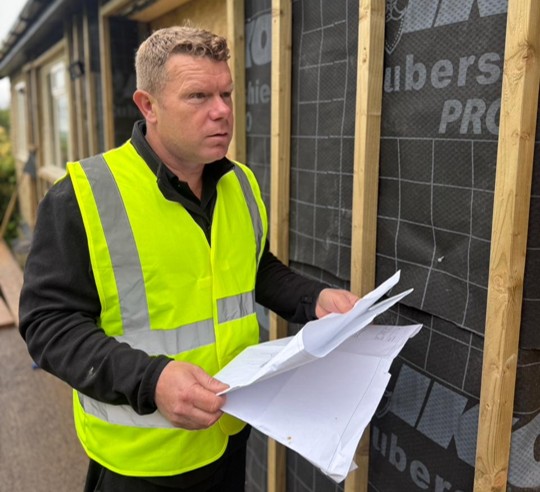
The workflow above is not generic methodology. It is the day-to-day responsibility of Leon Clift, JNR’s Project and Contracts Manager. Leon owns programme delivery, multi-trade coordination, CDM 2015 governance, and Building Safety Act dutyholder compliance on every active project — so the legal and operational accountability sits with a named individual who is on site, not an abstract role on a page.
“It was important to us that he was a member of the Federation of Master Builders and then when we spoke to people locally, they all recommended him. He is generally acknowledged to be the best in the area, from speaking to many of the tradesmen we’ve spoke with during the last few months. We would definitely recommend Julian’s company to anyone who wanted such work.”
The most effective Design-to-Build projects start before the drawings are finalised.
Whether you have a napkin sketch or a full tender pack, the first conversation is free.
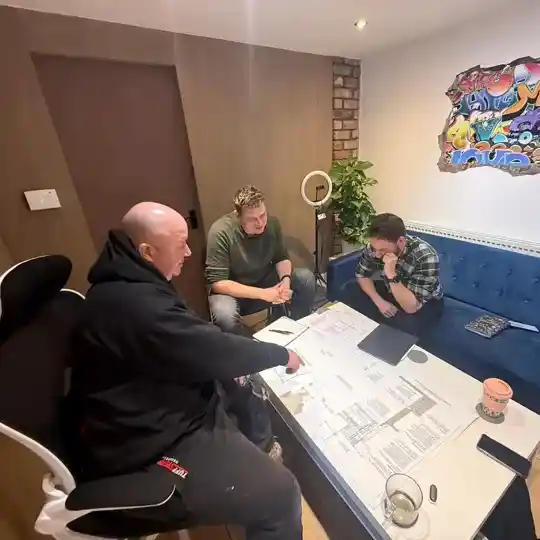
No. We frequently partner with leading architects, but engaging us early in the feasibility stage allows us to advise on structural constraints and buildability before you spend heavily on complex design work.
Under CDM 2015 regulations, projects require a Principal Contractor to manage health and safety. We take on this legal responsibility, managing site discipline, trade coordination, and regulatory compliance so you are protected.
Our professional approach is built on transparent pricing and documented variations. If you wish to change a specification during the build, we provide clear cost and programme implications before proceeding, reducing the risk of disputes.
Yes. For residential projects of meaningful scale we recommend the JCT Homeowner Contract — it formalises scope, payment terms, and dispute resolution in a way that protects both client and contractor. We can advise on which JCT contract suits your project at the feasibility stage.
We document every variation with cost and programme implications before proceeding, signed off by you. This prevents the post-completion disputes that occur when changes are made verbally and reconciled at the end. Transparent variation management is a core part of our Principal Contractor responsibility.